Oh Yes It Is! Five Panto Tricks That Turn a Polite Uke Gig into a Proper Singalong

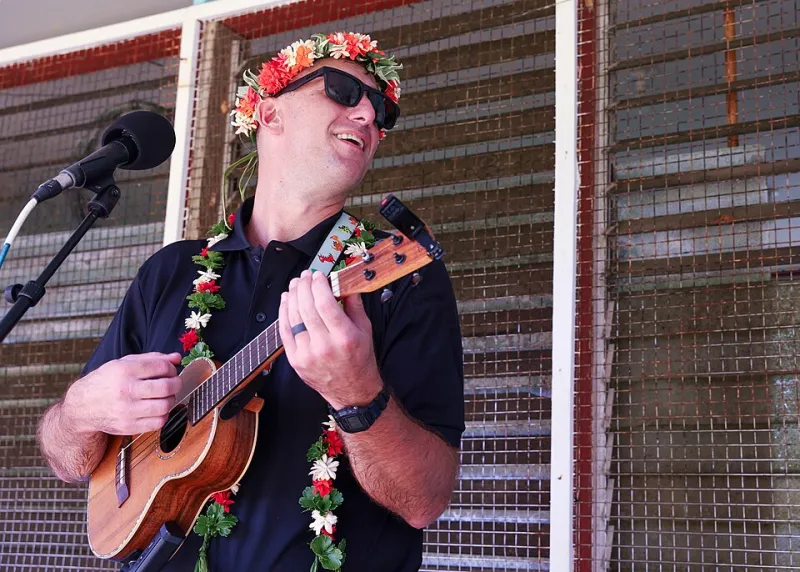
Photo: James Abbott from West Kelowna B.C., Canada, CC BY-SA 2.0, via Wikimedia Commons
British pantomime is a machine for making strangers behave like a room full of friends. It gets grandparents booing a man in a wig, toddlers shouting at the floorboards and teenagers singing a song they swore they didn’t know. Ukulele bands, by contrast, often finish a gig to that most British of sounds: polite, respectful applause and the clink of a few glasses.
With the 2026 panto season about to crank into life, it is worth asking what a four-string outfit could borrow from the oldest crowd-pleasing tradition in the country. Not the thigh-slapping. Not the frocks, necessarily. But the stagecraft — the bits that turn an audience from spectators into participants. Ukes of Hazzard has spent enough time in village halls and back rooms to know that a ukulele gig is already halfway to panto. It just needs a nudge.
1. Give the audience a scripted job — the ‘Oh no it isn’t’ principle
Panto works because nobody has to invent their response. The dame says ‘Oh yes it is,’ the audience says ‘Oh no it isn’t,’ and the whole room is suddenly in on the joke. Ukulele bands can steal this without dressing anyone up as Widow Twankey.
Pick one song early in the set and build in a two-word response. It could be as simple as: ‘When I say four strings, you say big grins.’ Or teach the audience to shout ‘one more!’ before the last chorus of a well-known song. The trick is to script it, rehearse it and then pretend you have not rehearsed it. Say it twice in the soundcheck, mention it once from the stage, then cue it with a raised eyebrow. By the second chorus, the front row will be doing it without being asked. The back row will join in when they realise it is not a test.
Do not overdo it. One call-and-response moment per set is delightful. Four is a pantomime horse that has bolted.
2. Cast a proper villain — even if the villain is a barre chord
Every panto needs a baddie: a sneering Abanazar, a scheming Rat King, someone for the audience to boo with real feeling. A ukulele band can have one too, and it does not need a costume budget. It needs a shared enemy.
The obvious candidate is the E chord. Or the dreaded barre chord. Or the moment when a string goes flat halfway through ‘Brown Eyed Girl’. Give the villain a name — Sir Barrington Barre Chord has a nice ring to it — and let the audience boo whenever he appears. If you have a band member with a theatrical streak, let them wear a cheap cape and point at the chord chart like a disappointed panto uncle. The audience gets a laugh, the band gets a running joke, and suddenly a technical wobble becomes part of the show rather than a gap in it.
Keep it gentle. Panto villains are booed, not bullied. The goal is a shared giggle, not a hostage situation.
3. Silly props are cheaper than a lighting rig
Panto props are gloriously low-tech: a pantomime horse, a giant pumpkin, a bench that is clearly a bench. Ukulele bands can follow suit. A feather boa, a laminated ‘APPLAUSE’ sign, a giant wooden spoon for the raffle — none of it requires a fairy godmother or a follow spot.
The rule is simple: only bring props that can be picked up and put down in two seconds, or held while playing. A box of egg shakers for the front row is panto gold. Handing out maracas is even better, provided you accept that one will end up in someone’s pint. A sign that says ‘CHORUS’ in letters big enough to read from the back of a rammed village hall does more for a singalong than any amount of between-song banter about the setlist.
Store the props in a plastic box labelled ‘PANTO BOX’. It makes you look organised. It also means you will not leave the boa in a pub car park in Wiltshire.
4. The song-sheet moment: give them the words and permission
Panto audiences sing because they know the songs and they are allowed to be loud. Ukulele audiences often know the songs too, but they are not sure whether joining in is the done thing. Solve this with a song sheet — large print, no chord diagrams, just the chorus in a font that does not require reading glasses.
Choose songs with repeatable choruses. ‘You Are My Sunshine’ works. ‘Leaving on a Jet Plane’ works. ‘Sweet Caroline’ is panto in a wig: the ‘ba ba ba’ needs teaching once, and then the room will do it for the rest of the night. Have one band member act as chorus leader, mouthing the words like a friendly panto dame. Point at the audience. Nod encouragingly. Do not stare at them like a teacher waiting for an answer.
Someone will hold the sheet upside down. Someone else will sing the wrong verse with tremendous confidence. This is not a problem. It is the point.
5. The walk-down finale — and the bit where everyone joins in
Panto ends with a company number, a shower of sweets and the feeling that the audience has been part of the show. A ukulele band can do the same with a communal finale. Invite anyone who owns a ukulele to come up for the last song. Keep it to three chords — C, F and G7 will do — and hand out a giant chord sheet. If the venue has a couple of loaner ukes, even better.
The structure matters more than the perfection. Play the chorus once with the band. Stop. Let the audience sing it back. Bring the band in again. Then do the whole thing once more, slightly faster, with the shakers going. End with a bow, a thank-you and the date of the next gig. It is not complicated, but it is generous, and generosity is what panto has been selling for two hundred years.
You do not need a fairy godmother to make this work. You need a cape, a song sheet and the willingness to look a bit daft in front of strangers. Which, let’s be honest, is not a million miles from playing the ukulele in the first place.