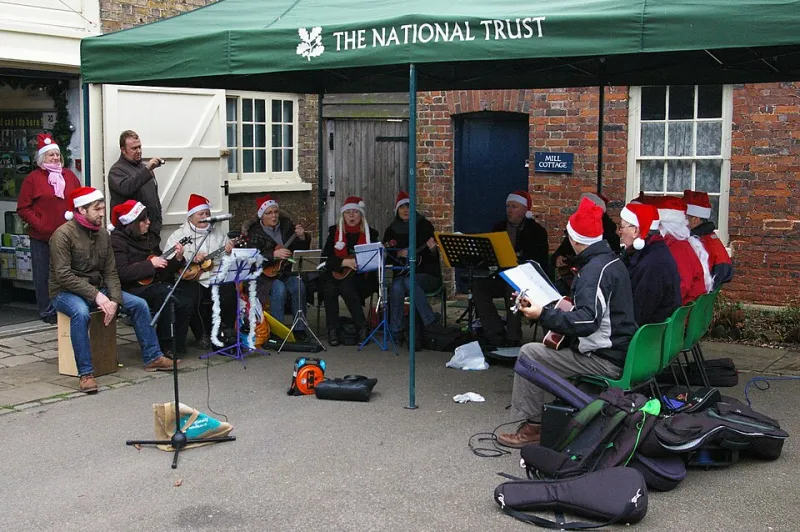
Twelve Strangers, Three Chords, One Hour: Inside the Library Ukulele Taster

Photo: ukulele workshop beginners in library community room with chord charts, via i.pinimg.com
It is a wet Saturday morning in November 2026. The community room of a British library smells faintly of carpet, tea and ambition. Twelve people have signed up for a free ukulele taster session. Six own a ukulele they have never properly tuned. Four are here because a friend said it would be a laugh. One has brought a guitar, which is the wrong instrument and also the right energy. One is already playing ‘Wonderwall’ at full volume, and the session has not officially started.
Welcome to community music-making. The goal is not to produce virtuosos in sixty minutes. The goal is to get twelve strangers playing one song together, badly but joyfully, and to send them home with a chord chart and the feeling that the ukulele is not just for people who already know what they are doing. At Ukes of Hazzard we have done enough of these to know the formula works — with a bit of planning and a lot of patience.
Before the first strum: book the room, bring the box
Book the library’s community room, not the reading area. Libraries are wonderful places, but they are not designed for twelve people playing ‘You Are My Sunshine’ while a local historian tries to research the parish records. Ask the librarian about the tea urn, the fire exits and whether the room has a piano nobody has touched since 1987. Say yes to the tea urn.
The kit list is short: loaner ukuleles if you have them, clip-on tuners, spare strings, large-print chord charts, a sign-in sheet for your community-outreach records and a plastic box of shakers. Bring a spare ukulele for the person who brings a guitar. Bring a sense of humour for the person who brings a banjolele.
Set the room up in a semicircle. It feels less like a classroom and more like a slightly disorganised club. Put the tea at the back. Put the chord chart on the wall where everyone can see it, and then put another one on the floor for the person who will inevitably sit on the first one.
The first ten minutes: tune, names, and lowering the bar
Start by admitting that nobody is born knowing how to play the ukulele. Then prove it by tuning a string badly and laughing. Hand out tuners. Show everyone how to tune G-C-E-A, and accept that at least two people will turn the wrong peg and snap a string. This is why you brought spares.
Go round the room for names and one reason why they are here. The answers will range from ‘I inherited it from my nan’ to ‘I wanted to meet people’ to ‘my therapist suggested it’. Write none of them down. Just nod.
Then say the line that unlocks the room: ‘The bar is on the floor, and we will trip over it together.’ It sounds corny. It also works. Twelve people visibly relax when they realise they are not being graded.
Three chords, no cowboys: C, F and G7
C is one finger. F is two, but the second one is awkward. G7 is three, but forgiving. These three chords can carry a ridiculous number of songs, and they are the backbone of the taster session.
Teach C first. Get everyone to strum once. Then four times. Then say the chord name out loud as they play it. Move to F. Expect buzzing. Show them that the buzzing is normal and that the cure is pressing slightly closer to the fret, not squeezing the neck like a stress ball. Move to G7. Play C, then F, then G7, then C again. Do it slowly. Count out loud. Make a joke about the chord of shame. Then move on before anyone has time to feel discouraged.
Have a helper circulate. The helper’s job is to fix finger positions, offer a quiet word and stop the person at the back from playing ‘Wonderwall’ at full volume during the explanation. More on that shortly.
The Wonderwall problem (and other acts of gentle management)
Every taster session has a Wonderwall enthusiast. They are not a villain. They are a person who knows one song and is keen to share it. The problem is that ‘Wonderwall’ at full volume while twelve beginners are trying to learn C is not community music; it is a hostage situation with a capo.
The tactic is not confrontation. It is redirect. Give the enthusiast a job: page-turner, shaker distributor, official timekeeper for the chord changes. If they are genuinely advanced, ask them to demonstrate a quiet strum and make it a challenge. ‘Can you play that so quietly that the librarian at the front desk doesn’t hear?’ It turns a disruption into a demonstration.
If they persist, use the amnesty box. A shoebox labelled ‘SONG REQUESTS FOR LATER’ works surprisingly well. ‘Wonderwall’ goes in the box. So does ‘Stairway to Heaven’, ‘Smells Like Teen Spirit’ and anything by Queen that requires more than three chords and a falsetto. The box is not a rejection. It is a promise that there will be a later.
The song that makes it click
Around the thirty-minute mark, teach ‘You Are My Sunshine’. It has a chorus everyone half-knows, a verse that repeats, and it fits C, F and G7 without much fuss. Teach the chorus first. Sing it a cappella. Then add one strum per chord. Then two. By the forty-minute mark, the room should be playing and singing at the same time, which is the moment the taster session becomes a ukulele choir.
It will not be tidy. It will sound like a cement mixer falling down a short flight of stairs. Someone will be half a beat behind. Someone else will be a whole verse ahead. The person with the guitar will be playing the wrong chords with tremendous confidence. None of this matters. The important thing is that twelve strangers are making a noise together and nobody is leaving.
The final ten minutes: the performance and the sign-up sheet
Finish with a ‘performance’. Play ‘You Are My Sunshine’ twice. The second time, add shakers and ask the audience to sing the chorus back to the band. Record it on a phone if everyone agrees. Take a bow. Then do the gentle sell: the next session, the local ukulele club, the Ukes of Hazzard gig at the pub next month, the library’s own community noticeboard.
Have a sign-up sheet by the door. Hand out chord charts. Thank the librarian by name — loudly, so the rest of the library hears that the room booking was a good idea. Then drink the tea, pack the box and accept that one string will have snapped, one shaker will have gone missing and one person will ask if they can borrow a ukulele for a week.
That is not chaos. That is a community choir in its first wobbly hour. And it started with three chords and a room above a library.