Runner Beans and a Rousing Chorus: The Allotment Hut Is Your Band’s Next Big Room
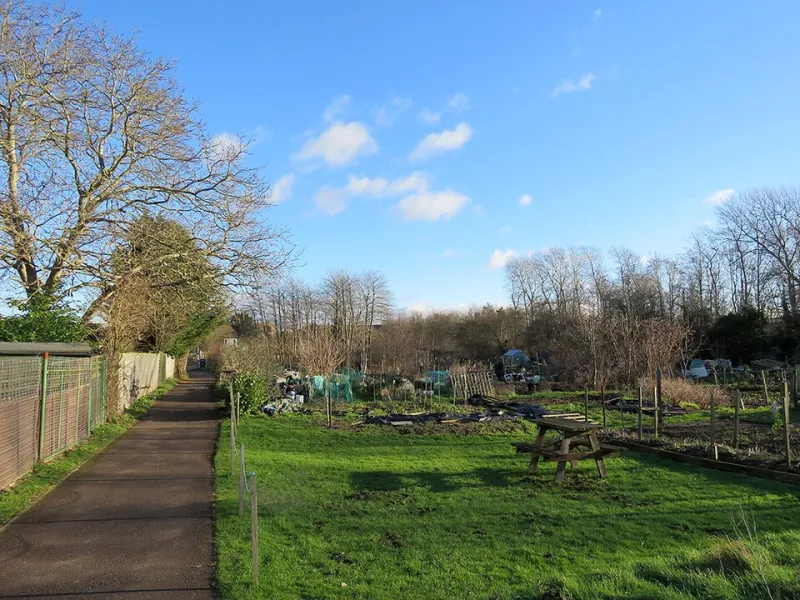
Photo: John Sutton , CC BY-SA 2.0, via Wikimedia Commons
There is a particular sort of British winter evening that smells of paraffin, wet coats and an awful lot of cake. It happens in a hut at the far end of a suburban allotment site, where the committee has laid out a trestle table, a raffle, and a faint air of panic. The booked entertainer — a man with a keyboard and an unshakeable commitment to the works of James Last — has pulled out. Somebody’s cousin has suggested “a bit of live music”. That is your cue, and you should be taking it.
Allotment societies, horticultural clubs and garden associations are one of the most overlooked gig circuits in the country. They meet monthly, they run winter socials, seed swaps, harvest suppers and summer shows, and they need the same thing every single time: something cheerful, something cheap and something that doesn’t require a three-phase power supply. Four ukuleles and a bloke with a shaker do not merely fit the bill. They are the bill.
A crowd that has absolutely nowhere else to be
The great advantage of a village hall full of plot-holders is that the audience is, in the kindest possible sense, contained. There is one door. The car park is a muddy strip behind the compost bays. Nobody is going to drift off to a better party at nine o’clock, because there isn’t one.
What you get instead is a proper cross-section. Sharp-elbowed retirees who have been coming since 1974. Young couples with a newborn and a raised bed. A teenage lad who is genuinely, unexpectedly into beetroot. That mix is a gift for a ukulele band, because you can run a set that starts with something for the grandparents, tips into a singalong for the middle, and lands somewhere daft enough to get the teenagers grinning.
And they sing. Give an allotment crowd a chorus they recognise and they will belt it out with the enthusiasm of people who have spent all week quietly muttering at pigeons.
The site secretary is the promoter now
Forget booking agents and £200 deposits. On this circuit, the person who decides whether you play is a volunteer with a clipboard and 40 unread emails about the state of the communal water butt.
Track down the society through the parish newsletter, the noticeboard by the gate, or the local allotment federation. Send a short, warm note. Not a press pack. Not an EPK with a drop-down menu. Just: who you are, where you’re from, what a 40-minute set sounds like, and what you’d need. Mentioning that you can play entirely unplugged will do more for your chances than a glowing review in a listings magazine nobody reads.
Then make the offer easy. Say you’d be happy to play for the raffle takings, a donation to society funds, or a plate of whatever’s on the bring-and-buy table. Most committees have a small entertainment budget and no idea what to spend it on. Be the simple, no-fuss answer and you’ll be booked before you’ve finished explaining what a baritone is.
Building a set for people holding a plate
An allotment social is a moving crowd. People are queuing for tea, inspecting a second-hand hoe, buying raffle tickets and having a heated debate about tomato blight. You are not the main event so much as the weather — you set the temperature of the room.
That means no ten-minute odyssey of self-penned folk. Keep it brisk. Two- or three-chord songs with choruses that land on the second hearing, ideally with a bit of business attached: a clap, a stamp, a call-and-response that lets a table of strangers shout at each other in the name of entertainment.
Have a short introductory line for each song. Thirty seconds of context — who sang it, why you love it, which of you has to transpose it because of a bad finger — buys you more goodwill than any amount of fancy playing. And keep one genuinely gentle number in reserve for when somebody starts to look wobbly at the back. Play that one quietly, then get everyone back on their feet with something ridiculous.
The soundcheck is the kettle going on
This is not a venue with a stage. It’s a room with a wooden floor, a low ceiling, a tea urn in the corner and a faint hum from a fridge that has been there since the Coronation.
Don’t bother with monitors. Turn up, sit on the edge of the little raised platform if there is one, and play a verse while the room fills. The kettle going on is your real soundcheck: if you can hear the ukes over 60 people catching up on each other’s hips and knees, your balance is right. If you can’t, move closer together, ease off the strumming and let the singing do the heavy lifting.
One practical note: tile floors and low ceilings bounce treble around like a pinball. Play a touch softer than feels natural. The room is your amplifier, and it’s a generous one once you stop fighting it.
The marrow economy of repeat bookings
Here is the thing about a society: it has a calendar. Harvest supper in September. A seed swap in February. The AGM in March, which always needs light relief. The summer show, which needs a bit of noise between the giant onion classes. A Christmas social that needs someone other than a man in a waistcoat to lift the mood.
Play one of those evenings well and you have not booked a gig. You have booked a relationship. Secretaries talk to each other. The neighbouring site’s treasurer will hear about you from the woman who runs the raffle, and next winter you’ll be offered three dates before you’ve had a chance to check your diary.
There is a fair chance you’ll also be offered a bag of courgettes, a jar of green tomato chutney and a slowly developing understanding of the finer points of crop rotation. Accept all three. It’s cheaper than merch.
Go on, ask
So find your nearest allotment society, find the person with the clipboard, and offer them four strings and a smile. The room will be warm, the tea will be strong, and there is every chance that the Bring and Buy stall will outshine you during the first verse. That’s fine. By the last chorus, the woman who grew the prize marrow will be on her feet, and you’ll have a gig every winter until the rhubarb gives up.