The Jam Jar Oracle: One Hundred Song Slips and the Crowd Behind Them
At some point in early 2026, between a pub back room in the Midlands and a village hall with a tea urn the size of a small moon, we stopped guessing what audiences wanted and started asking. We placed a clean jam jar on the merch table, next to the stickers and the one cassette we keep for luck, and taped a label to it: 'One song. One slip. No judgement.' We supplied pencils. We supplied a small sharpener. Then we sat back and watched the British public reveal itself, one folded bit of paper at a time.
By the end of the spring and summer, we had 100 slips. Not 100 useful slips, mind. But 100 real ones. Some were neat, some were urgent, one was written on the back of a beer mat and another appeared to be a shopping list with a chorus. Together they made a surprisingly sharp portrait of the great British singalong: what we ask for, what we secretly hope the band can busk, and what happens when a room decides it wants to be a choir.
The Rules of the Jar
The jar had only three rules. One song per slip. No requests for anything we could not reasonably play on four strings and a sense of hope. And no arguing with the jar. The last rule was tested almost immediately by a man in a raincoat who wanted to explain, at length, why his choice was objectively correct. The jar, being a jar, remained neutral.
We opened the lid after each gig, often while packing away cables and eating a crisps-based dinner. The slips fell into rough tribes. There were crowd-pleasers, curveballs, illegible masterpieces, requests clearly aimed at a grandparent, requests clearly aimed at a toddler, and the inevitable Oasis entry. We began to look forward to the jar more than the soundcheck. It was cheaper than market research and considerably more entertaining.
The Crowd-Pleasers: Songs Everyone Thinks They Know
About a third of the slips were what you might call social glue. Sweet Caroline. Country Roads. Dancing Queen. Delilah. Mr Brightside. Songs that do not need a rehearsal so much as a public liability waiver. These are the requests that arrive in confident handwriting, often with the chorus spelled out phonetically, as if the band might have forgotten the bit that goes 'ba ba ba'.
What surprised us was not that people asked for them. It was why. One slip simply said: 'Sweet Caroline — for my mum, she does the arm thing.' Another read: 'Mr Brightside, but only if the room is up for it.' That little conditional was oddly moving. The British crowd does not just want a song. It wants permission to join in without looking daft. The request jar is often a request for cover.
The Curveballs: Requests From Another Dimension
Then there were the slips that made us put down the crisps. A request for the theme from Postman Pat. A request for The Archers theme, written with tremendous seriousness. A demand for a song we had never heard of, followed by the helpful note: 'It's on the radio sometimes.' One child asked for a song from a film, then added, 'not that one, the other one.'
These are the slips that keep a band honest. You cannot play everything, and you should not try. But a curveball can be a gift if you have ten minutes and a sense of humour. We learned that a short burst of a well-known TV theme, played with total commitment, can buy more goodwill than a perfect rendition of something in the setlist. The trick is to treat it as a joke shared with the room, not a puzzle to solve in public.
The Illegible Masterpieces
Some slips were less song requests and more abstract art. One read 'Roxanne but not that one', which narrowed it down to several thousand possibilities. Another said 'the one with the woah-oh bit', which is either very precise or completely useless depending on your record collection. A third appeared to be a drawing of a dog.
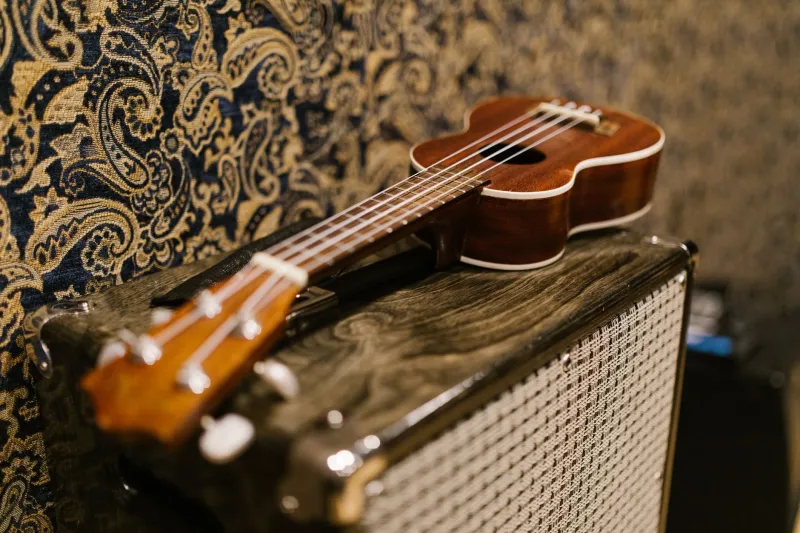
We kept these. They are now pinned to the inside of the ukulele case, a small museum of human optimism. Occasionally, a brave soul would claim one at the interval and explain what they meant. This became one of our favourite bits of the night: the moment someone stands up and says, 'That's mine, and it's actually a request for my wedding song.' The jar had turned into a conversation starter.
And, Yes, Wonderwall
We need to talk about Wonderwall. It appeared on nine slips, which is fewer than we expected and more than we needed. It arrived in many forms: neat, scrawled, abbreviated, and once accompanied by a small drawing of a guitar with a tick next to it. We are not anti-Wonderwall. Nobody who plays a ukulele in public is in a position to sneer at a crowd favourite. But the jar taught us that the song is less a request and more a reflex. It is the default setting of the British singalong.
The useful lesson was this: people do not always want the song itself. They want the feeling of everyone knowing the same thing at the same time. If you can give them that feeling with something else, they will usually forgive you. If you cannot, you had better learn the chorus.
What the Geography Says
We played across the country, and the slips had a regional accent. A Newcastle audience asked for Fog on the Tyne. A Cardiff crowd wanted Delilah. A Glasgow hall produced Loch Lomond and a note that said, 'If you cannae do it, dinnae bother.' A pub in the south-west asked for something we could only describe as 'a sea shanty, but fun'. These were not scientific findings. They were just reminders that a singalong is local as well as national. The big songs travel. The best requests stay close to home.
The Generational Pencil Gap
Handwriting told its own story. The under-tens wrote in marker pen, usually at an angle, often with a drawing. Teenagers used their phones to remember the title and then wrote it in tiny, careful capitals. Parents wrote in biro while holding a drink. Grandparents wrote in fountain pen and included the artist, the year and, occasionally, a suggested key. One slip read: 'We'll Meet Again — and I mean it.'
This was the jar's quiet magic. It put different generations in the same queue. The same room that asked for Mr Brightside also asked for a Vera Lynn song, a Disney ballad and something by Abba. The setlist could not possibly hold them all, but the jar showed us that the audience was wider than we sometimes assumed. A good ukulele gig is not a nostalgia night or a youth club. It is a temporary republic of people who all know the words to something.
The Alchemy of a Good Request
The best requests had three things in common: a simple chorus, a clear emotional target and no more than one key change. They were songs people could join on the second line, not the third verse. They were often songs that had been sung at weddings, funerals, football grounds or school discos. The jar was full of memories wearing song titles as disguises.
That is the strange alchemy of a singalong. It is not really about the song being good. It is about the room being ready. A request slip is a tiny vote for a shared moment. Our job is to read the room, not just the paper.
How to Keep the Jar From Hijacking the Set
If you try this at home, here is what we learned. First, set expectations early: the jar is an oracle, not a contract. Announce that you will pick a few requests and explain that the rest go into the idea box for next time. Second, open the jar at the interval, not before the first song, so you have time to choose sensibly. Third, prepare a short request medley of repeat offenders: Wonderwall, Sweet Caroline, Country Roads, Dirty Old Town, Dancing Queen and one local favourite. That gives you a pressure valve without dismantling the set.
Fourth, protect the plot. Keep requests out of the first fifteen minutes and away from the big finish unless you know they will land. Use them as a mid-set lift or an encore treat. Fifth, have a get-out clause: if a request is impossible, say so with a grin and offer the chorus instead. Sixth, never let one person's obscure favourite become a hostage situation. The jar serves the room, not the loudest slip.
Finally, keep the jar. Not for the requests, but for the evidence. The slips are a record of what people hoped for on a particular night in a particular hall. They are funny, daft and occasionally profound. Ours now lives on the merch table with a fresh pencil and a new label: 'One song. One slip. We'll see what we can do.' That feels about right for a ukulele band. Four strings, big grins, and a jar full of hopeful handwriting.